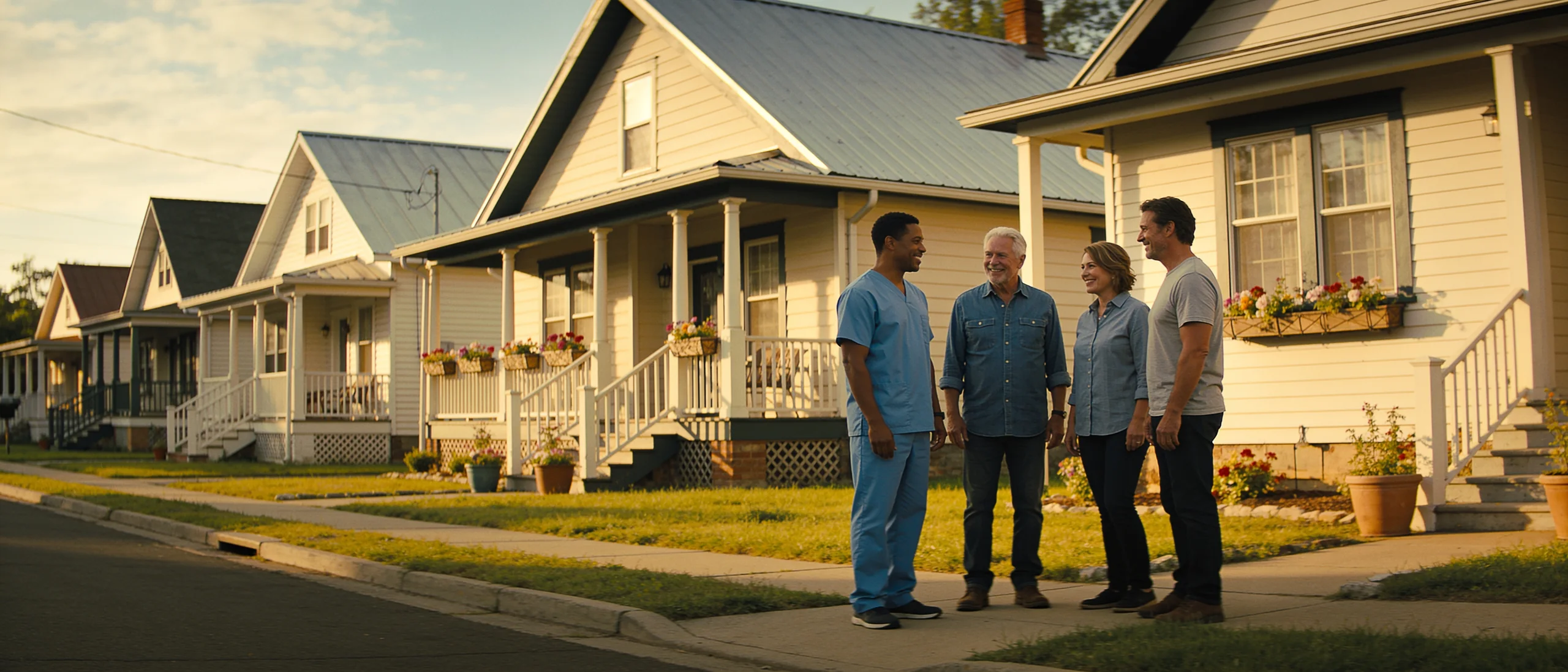



Four working neighbours talking on the sidewalk of a single-story cottage street at golden hour

Around the USA

A country short of homes for the people who keep it running

Nearly half of America’s renters pay more than they can afford, every state is underbuilt, and the jobs that hold a town together pay less than a modest two-bedroom costs. Here is what the national numbers say — and what states and towns are doing about it.

The scale of it

Nearly half of America’s renters are paying more than they can afford

These are the headline figures from Harvard’s annual State of the Nation’s Housing report and the National Low Income Housing Coalition’s two national studies.

22.7 million

renter households — 49% of all renters — paid more than 30% of their income for housing in 2024, the most ever recorded.

12.1 million

of them were severely cost burdened in 2024, paying more than half of their income for housing.

7.2 million

rental homes short, nationally, for extremely low-income renters — homes that would have to be both affordable and available (2026).

$34.73

an hour: what a full-time worker needs to afford a modest two-bedroom at fair market rent in 2026. The average renter earns $24.84.

The 30% line matters because it is the standard every federal housing program uses: a household paying more than 30% of its income for rent and utilities is “cost burdened.” In 2024 that described 22.7 million renter households — nearly one in two — and the count has never been higher.

Renters are not alone. The same 2026 report counts 20.7 million homeowners, 24% of all owners, above the 30% line, and it finds that home insurance premiums rose 72% between 2019 and 2025. Home prices are up 54% since 2020, and the typical home now costs nearly five times the typical household’s income, against an average of 3.2 through the 1990s.

The number that explains the rest is the one about what disappeared. Between 2014 and 2024 the stock of homes renting for under $1,000 a month fell by 30%.

Sources: Harvard Graduate School of Design, news release on “The State of the Nation’s Housing 2026” (June 17, 2026) (opens in a new tab) · NLIHC, summary of “The State of the Nation’s Housing 2026” (July 2026) (opens in a new tab) · Enterprise Community Partners, “Five Key Takeaways from the 2026 State of the Nation’s Housing Report” (June 2026) (opens in a new tab) · NLIHC, “The Gap 2026” (opens in a new tab) · NLIHC, “Out of Reach 2026” press release (July 23, 2026) (opens in a new tab)

Where the gap is widest

Every state is short. The coasts and the Sun Belt are shortest.

No state has enough homes for its lowest-income renters, and in no state but one does the average renter’s wage cover a modest two-bedroom.

35

affordable and available rental homes for every 100 extremely low-income renter households nationwide in 2026. In Nevada there are 16.

49 states

plus D.C. and Puerto Rico where the average renter’s wage does not cover a modest two-bedroom at 40 hours a week (2026).

840,000

homes short in California alone in 2022, the largest gap of any state. Every one of the 50 states, and 198 metro areas, were underbuilt.

216 hours

a week at the minimum wage to afford a two-bedroom in New Hampshire in 2026, where the minimum is still the federal $7.25 — 165 in Texas, 130 in Massachusetts, 86 in Delaware.

The pattern is the same one Delaware sees at the beach, scaled up. Where land is scarce and demand arrives from somewhere else — a coastline, a ski slope, a booming metro — prices are set by incomes that were earned elsewhere, and the people who staff the place lose the bidding. NLIHC’s 2026 count of affordable and available rental homes per 100 extremely low-income renter households puts Nevada at 16, Oregon at 24, California at 25, and Arizona, Florida and Texas at 26 each.

Up for Growth’s 2024 report, measuring homes that should exist but were never built, named California, Texas, New York, Florida, New Jersey, Illinois, Washington, Georgia, Massachusetts and Arizona as the ten states with the most missing homes in 2022, and found the shortfall worsening in 24 states that year. Its 2025 update found the gap in “middle and sunbelt states” still growing in 2023, even as the national total eased.

The hours tell it most plainly. By NLIHC’s 2026 arithmetic, a minimum-wage worker needs 130 hours a week for a two-bedroom in Massachusetts, 125 in California, 123 in Hawaii, 121 in New York, 115 in Wyoming and 108 in Florida — and in states still at the $7.25 federal minimum the figure is higher still: 216 in New Hampshire, 165 in Texas. Even in Missouri, the lowest of any state, it is 59, a job and a half.

Sources: NLIHC, “The Gap 2026” (opens in a new tab) · NLIHC, “Out of Reach 2026” (July 2026) (opens in a new tab) · Up for Growth, “Housing Underproduction in the U.S. 2024” (October 2024) (opens in a new tab) · Up for Growth, “Housing Underproduction in the U.S. 2025” (November 2025) (opens in a new tab)

The supply math

What the country builds, and for whom

Up for Growth counts housing “underproduction” — the gap between the homes a state has and the homes its households need, including the households that never formed because they could not afford to. Nationally that gap was 3.78 million homes in 2023, down about 70,000 from 3.85 million in 2022, the second straight year of narrowing, which the report credits to more building and the end of the pandemic’s unusual migration. Since 2012, 109 metro areas — more than a third of those measured — have slipped from adequate into underproduction. Only 34 have met their need continuously since then; another 11 have climbed back out.

The pipeline is now shrinking again. For September 2026 the Census Bureau reported housing completions at a seasonally adjusted annual rate of 1,192,000 — 14% below September 2025 — with permits at 1,400,000, down 3%, and starts at 1,221,000, down 7.4% on the year (within the survey’s margin of error). Harvard’s researchers found single-family construction fell 7% in 2025 while multifamily construction rose only slightly.

The Census Bureau’s count of what was completed in 2025 fills in the rest. The median new single-family home completed in the United States measured 2,142 square feet; of the 484,000 new apartments completed, 42% had one bedroom. Eleven percent of new single-family homes in 2025 were built to be rented, not sold.

Sources: Up for Growth, “Housing Underproduction in the U.S. 2025” (November 2025) (opens in a new tab) · Congressional Research Service, “Estimates of a ‘Housing Shortage’” (IN12628, December 2025) (opens in a new tab) · U.S. Census Bureau and HUD, “Monthly New Residential Construction, September 2026” (CB26-162, October 20, 2026) (opens in a new tab) · U.S. Census Bureau, “Highlights of 2025 Characteristics of New Housing” (opens in a new tab) · NLIHC, summary of “The State of the Nation’s Housing 2026” (July 2026) (opens in a new tab)

How short is the country? Five estimates

National Association of Realtors (2020) 5.5M
Brookings (Q4 2023) 4.9M
Zillow (2023) 4.7M
Up for Growth (2023) 3.78M
Freddie Mac (Q3 2024) 3.7M

Homes the United States is estimated to be short, in millions. The estimates differ because they measure different things — vacant homes against a healthy vacancy rate, building against its historical pace, households that never formed. None of them is small. Compiled by the Congressional Research Service, December 2025; Up for Growth figure from its November 2025 report.

Who gets squeezed

The jobs every town depends on are the jobs that can’t afford the town

18

of the nation’s 25 largest occupations pay median wages below the two-bedroom housing wage in 2026. Seventeen pay below the one-bedroom wage.

80–120%

of area median family income: where teachers, paramedics, police officers and firefighters earned their median wage in most metros sampled in 2024.

32%

of middle-income renter households had a housing problem in 2023 — cost, crowding or condition — against 75% of lower-income renters.

68%

homeownership rate for middle-income households in 2023, down from 73% in 2003. The step from renting to owning has gotten longer.

The people in the middle of the income ladder are not the people the housing programs were built for. The Congressional Research Service’s 2026 review found that existing federal housing programs predominantly target low-income families, and that a teacher, paramedic, police officer or firefighter — median wage between 80% and 120% of the area median in most metro areas sampled in 2024 — generally earns too much to qualify. EMTs and emergency dispatchers earned below 80% in most of those metros. A full-time minimum-wage worker earned below 80% in every one.

The rent side of the ledger is the same story. NLIHC’s 2026 report found that 18 of the 25 largest occupations in the country pay a median wage below what a modest two-bedroom costs at fair market rent, and the average renter — at $24.84 an hour against a $34.73 housing wage — would need more than a full-time week to afford one in 49 states.

None of this is a story about people who cannot work. It is a story about people who do, and who used to be able to count on steady work turning into a mortgage. For households earning 80% to 120% of their area’s median, the homeownership rate fell from 73% in 2003 to 68% in 2023. That is the workforce-housing gap in one sentence.

Retail worker behind a store counter Healthcare worker with a stethoscope Tradesperson on a construction site A set of house keys handed over

Sources: Congressional Research Service, “Workforce or Middle-Income Housing: Analysis and Policy Considerations” (R48886, March 2026) (opens in a new tab) · NLIHC, “Out of Reach 2026” press release (July 23, 2026) (opens in a new tab)

The response

What communities around the country are doing

There is no federal definition of workforce housing, and the Congressional Research Service notes that only a handful of federal tools reach above 80% of area median income at all. So the answers are being built one state, one school district, one hospital and one nonprofit at a time.

States putting money behind the middle

Colorado created a Middle Income Housing Authority (opens in a new tab) by statute in 2022 (SB22-232) to finance rentals for households at 80% to 120% of area median income — 140% in rural resort communities — using bonds repaid solely from project revenue, with a goal of up to 3,500 units; it conditionally selected its first six projects in March 2023. Massachusetts’ Workforce Housing Initiative (opens in a new tab) has invested more than $100 million, up to $100,000 per home, in rentals for households under 120% of area median income.

Montana’s 2023 HB 819 put more than $175 million into workforce housing, including $106 million for a HOMES revolving loan fund that pays for the water and sewer lines new neighborhoods need; by April 2025 the state credited it with nearly 1,000 new homes under way. Utah’s 2023 S.B. 240 created a First-time Homebuyer Assistance Program administered by Utah Housing Corporation offering up to $20,000 toward a newly built home; funded with $50 million, it had helped 460 families by that November. Florida’s 2023 Live Local Act carried a $711 million appropriation for the state’s housing programs.
Changing what is legal to build

Several states have changed what towns must allow on ordinary residential lots. Oregon’s HB 2001 (2019) requires every city of 25,000 or more, and every city and county inside the Portland metro district, to permit all “middle housing” — duplexes, triplexes, quadplexes, cottage clusters, townhouses — wherever a detached house is allowed, and cities of 10,000 to 25,000 to allow a duplex on every such lot.

Washington’s HB 1110 (2023) goes further: cities of 25,000 to 75,000 must allow at least two homes per residential lot, and four near major transit or when one home is affordable; cities of 75,000 and up must allow four, and six near transit or when two are affordable — a density bonus written into state law. The state’s definition of middle housing runs “from duplexes to sixplexes, townhomes, courtyard apartments and cottage housing.” Florida’s Live Local Act requires counties to allow apartments and mixed-use housing in any commercial, industrial or mixed-use zone when at least 40% of the units are rental homes affordable for at least 30 years, and bars them from capping such projects below the highest density allowed anywhere in the county, or the tallest building allowed within a mile (or three stories).

Employers building for their own people

The Jefferson Union High School District in Daly City, California, opened 122 apartments for its faculty and staff in 2022, rents set at half the market rate, on a $75 million budget that included $33 million from a 2018 voter-approved bond. By September 2026 about 60% of the homes were occupied by credentialed teachers and roughly 70 people were on the waiting list. Districts across California are building; the Standard profiled three that have finished housing of their own, and San Diego Unified has completed the first of six planned projects.

Martha’s Vineyard Hospital raised $30 million to build 48 staff homes with 76 bedrooms, and selected 35 employees by lottery to move in from September 2025. St. John’s Health in Jackson, Wyoming, is building the 72-unit Hitching Post Apartments for its healthcare workers, funded by $13.7 million in philanthropy — fully raised by November 2025 — and $24 million from a voter-approved sales tax, with doors planned to open in early 2028.

Nonprofit builders

The Jackson Hole Community Housing Trust (opens in a new tab) has housed 673 people since 1991 — 232 of them in the last six years — in nine neighborhoods built for households earning under 120% of Teton County’s median, plus 35 rental homes it manages. On Martha’s Vineyard, the Island Housing Trust (opens in a new tab) has built permanently affordable homes since 2006 and has set a goal of 200 more, for rent and for sale, across all six island towns by 2030.

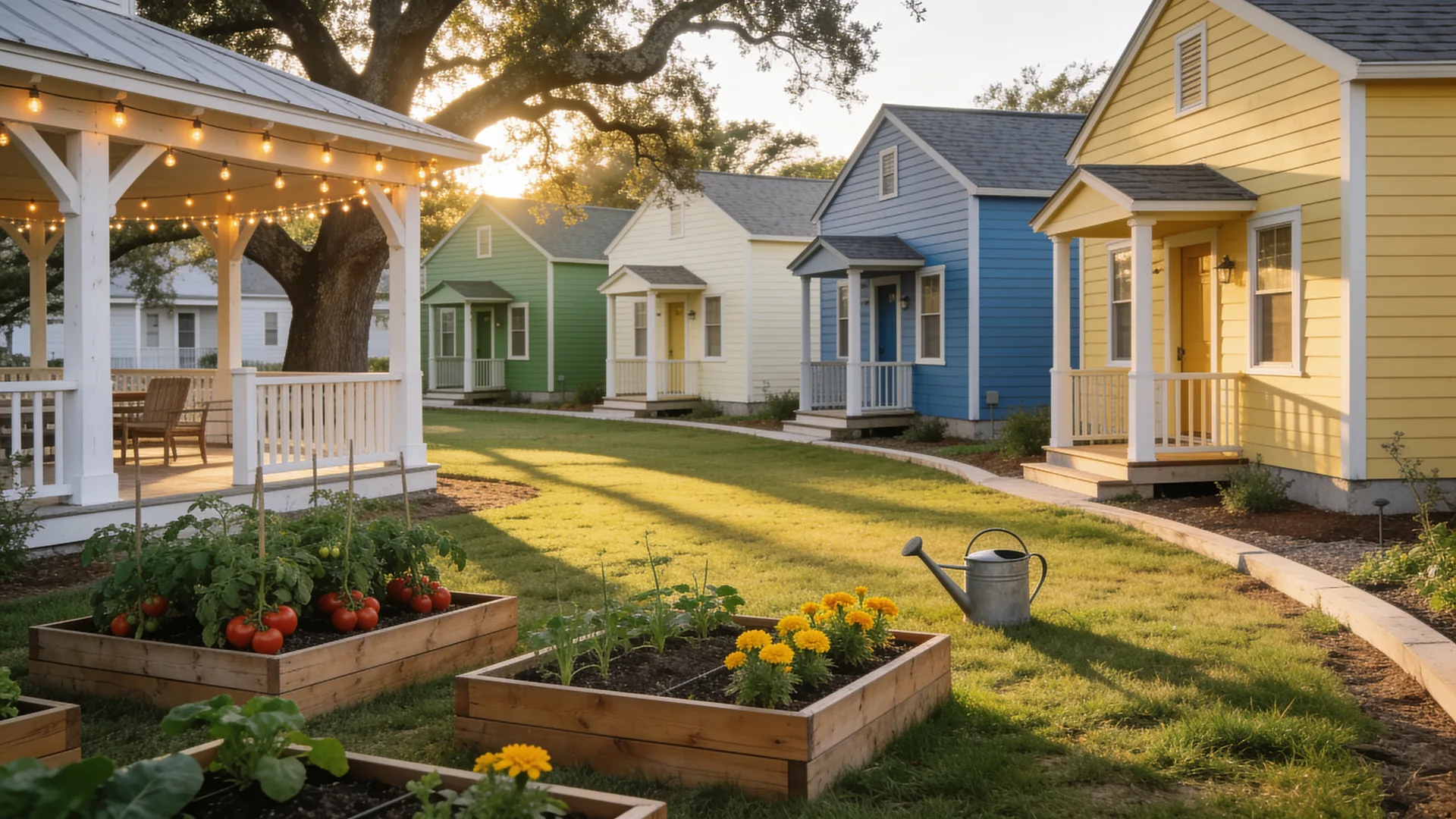
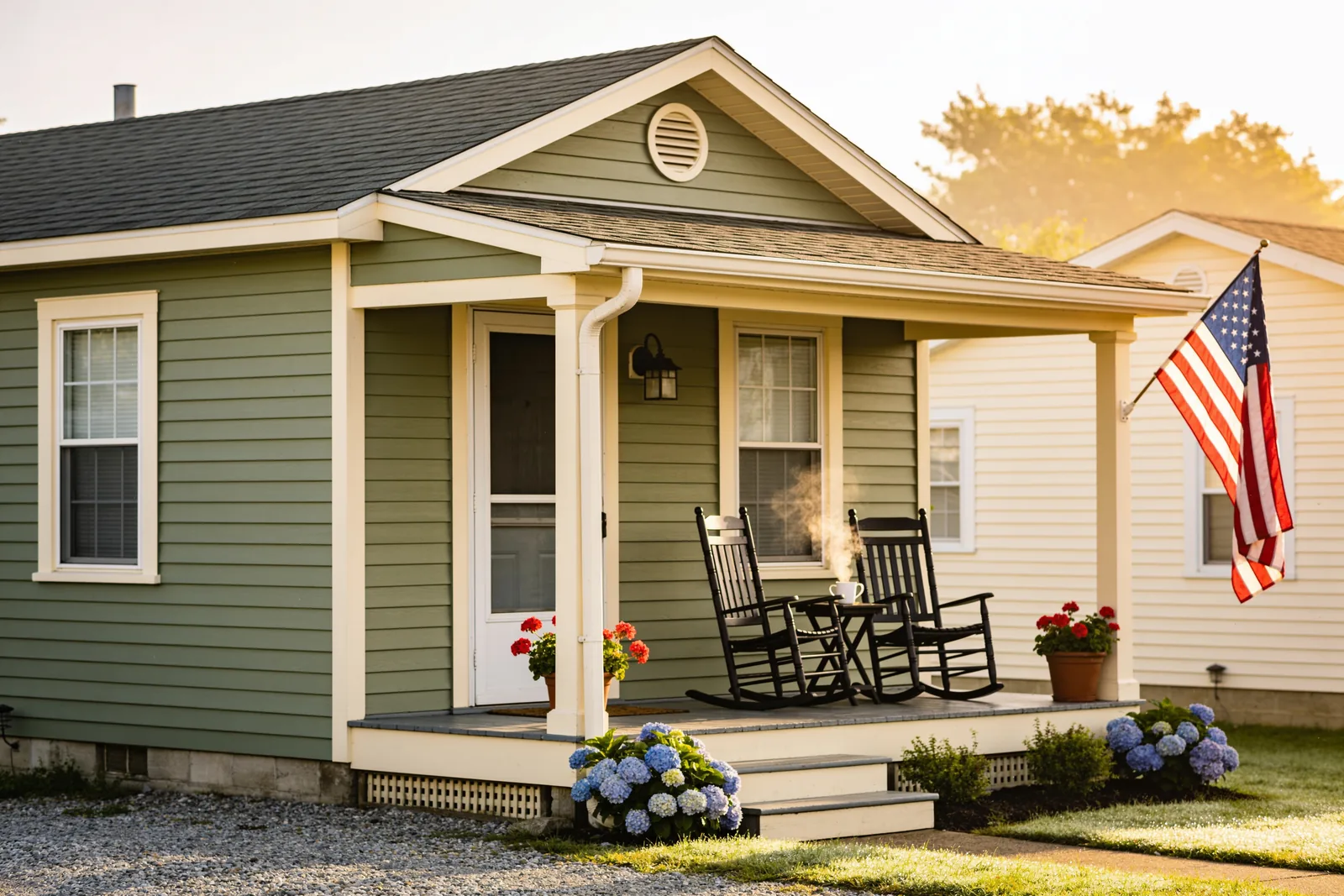
In Delaware, Little Living (opens in a new tab) is a 501(c)(3) building small stick-built cottage communities at cost for working households — the first is under construction in Georgetown, supported in part by a Healthy Communities Delaware community investment. The local picture is on our In Delaware page.

Cottages around shared raised garden beds at golden hour Cottage front porch with rocking chairs at sunrise

Sources: Congressional Research Service, “Workforce or Middle-Income Housing: Analysis and Policy Considerations” (R48886, March 2026) (opens in a new tab) · Colorado General Assembly, SB22-232 (signed June 3, 2022) (opens in a new tab) · Colorado Middle Income Housing Authority (opens in a new tab) · MassHousing, Workforce Housing Initiative (opens in a new tab) · Florida Senate, CS/SB 102 “Live Local Act” (approved March 29, 2023) (opens in a new tab) · Florida Statutes s. 125.01055(7) (opens in a new tab) · Office of the Governor of Montana, “Governor Gianforte Celebrates Impact of Housing Investments in Butte” (April 16, 2025) (opens in a new tab) · Utah Legislature, S.B. 240 “First-time Homebuyer Assistance Program” (2023) (opens in a new tab) · KSL, “Utah funded $50M for a new first-time homebuyer program” (November 26, 2023) (opens in a new tab) · Oregon Legislature, Enrolled House Bill 2001 (2019) (opens in a new tab) · Oregon Legislature, HB 2001 staff measure summary (2019) (opens in a new tab) · Washington Legislature, E2SHB 1110 final bill report (Chapter 332, Laws of 2023) (opens in a new tab) · Washington Department of Commerce, Middle Housing (opens in a new tab) · Building Design+Construction, “Bay Area school district builds 122 affordable apartments for faculty and staff” (December 2022) (opens in a new tab) · The San Francisco Standard, on school-district teacher housing (September 10, 2026) (opens in a new tab) · The Martha’s Vineyard Times, on Martha’s Vineyard Hospital staff housing (July 28, 2025) (opens in a new tab) · St. John’s Health, Hitching Post Apartments (opens in a new tab) · Jackson Hole Community Housing Trust, About (opens in a new tab) · Island Housing Trust, About (opens in a new tab)

FAQ

Questions about workforce housing across the country

How big is the national housing shortage, really?
It depends on how you count. The Congressional Research Service’s December 2025 review lists estimates from 3.7 million homes (Freddie Mac, third quarter of 2024) to 5.5 million (National Association of Realtors, 2020). Up for Growth’s 2025 report puts underproduction at 3.78 million homes in 2023, down from 3.85 million the year before. A separate NLIHC measure counts a 7.2 million shortage of rental homes affordable and available to extremely low-income renters in 2026. The methods differ; the direction does not.
What counts as “workforce housing” nationally?
There is no federal statutory definition. The Congressional Research Service’s March 2026 report describes it as housing for households who earn too much for most subsidies and too little for the market near their jobs, and notes that state and local programs commonly cap eligibility at 120% of area median income, sometimes with a floor of 60% or 80%. In 2024, teachers, paramedics, police officers and firefighters earned median wages inside that 80-to-120% band in most metro areas sampled. Our Definitive Resource has the full definition and the income math.
Which states have the widest gap?
By NLIHC’s 2026 count of affordable and available rental homes per 100 extremely low-income renter households, Nevada has 16, Oregon 24, California 25, and Arizona, Florida and Texas 26 each, against a national 35. By the hourly wage needed for a two-bedroom in 2026, California, Hawaii, Massachusetts, New York and New Jersey rank highest. By homes never built, Up for Growth found California 840,000 short in 2022, with Texas, New York, Florida and New Jersey also among the ten states with the most missing homes.
What is actually working?
Four things, in combination. States changing what is legal to build: Oregon (2019) and Washington (2023) now require their larger cities to allow duplexes, triplexes, cottage clusters and the like on ordinary residential lots, and Florida’s 2023 Live Local Act requires counties to allow apartments in commercial and industrial zones when at least 40% of the units are rental homes affordable for at least 30 years. States putting money behind the middle: Colorado’s Middle Income Housing Authority, Massachusetts’ Workforce Housing Initiative, Montana’s HOMES infrastructure fund and Utah’s first-time buyer program. Employers building for their own people: school districts and hospitals from Daly City to Martha’s Vineyard to Jackson. And nonprofit builders, including Little Living (opens in a new tab), which builds at cost; its first cottage village is under construction in Georgetown, Delaware.

The gap is national. In Delaware, the answer is being built.

Little Living is a 501(c)(3) building cottage communities at cost for the working households this page is about. Donations are tax-deductible and become land, lumber, and front doors.